A breakdown of how product formulation, customization, testing, packaging, production, and launching your product works with a manufacturer.
1. What is your idea?
Before a product is ever formulated, there’s an idea behind it. Product development starts with understanding what you want to create, why it needs to exist, and who it is meant to serve. A successful product isn’t simply a collection of ingredients—it’s a solution designed around a specific need, audience, and experience. Before moving into formulation, take time to define the problem you’re solving, identify your target customer, and determine the benefits and experience you want your product to deliver. This foundation will guide every decision that follows, from ingredients and formulation to packaging and positioning.
2. Research & Positioning
Once you have a clear idea of what you’re creating and who you’re creating it for, the next step is understanding where that product fits within the market. Research and positioning help you determine whether your idea truly meets your customer’s needs, how similar products are already performing, and where there may be an opportunity to do something better. You don’t always need to reinvent the wheel; sometimes the strongest product is one that takes what already works and improves upon it. This means studying competitors, identifying market gaps, researching ingredients connected to your customer’s pain points, and considering pricing, margins, and potential return on investment. The goal is to build a product that isn’t only desirable—it’s positioned to compete and make business sense.
3. Formulation & Production Development
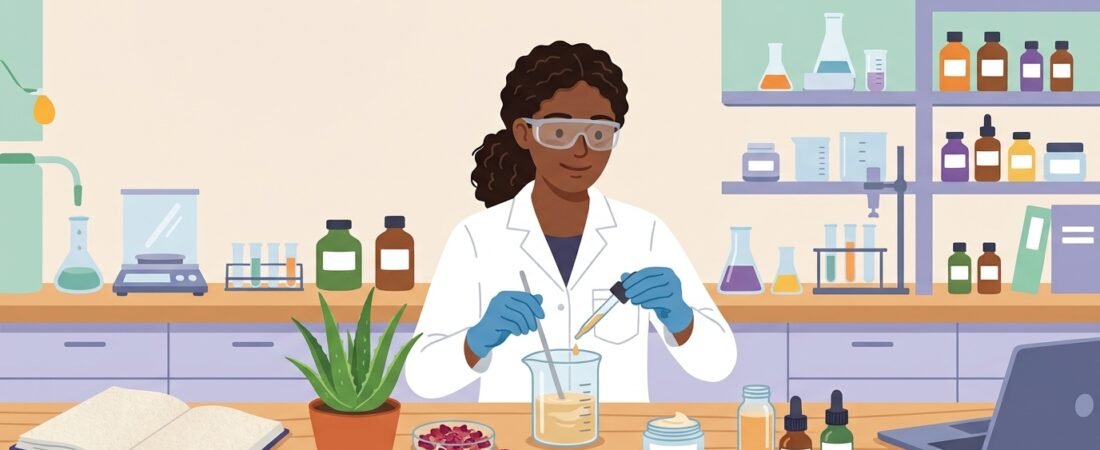
With a clear concept and a better understanding of the market, you can begin turning the idea into an actual product. Formulation and product development is where research becomes tangible. The ingredients you choose should have a purpose and connect back to the needs of your target customer, while also supporting the texture, scent, color, performance, and overall experience you want to create. This is also where decisions around natural versus synthetic ingredients, preservation, stability, and product safety come into play. And remember, the first formula is rarely the final formula—developing a successful product often requires creating, testing, adjusting, and refining the formula until it performs the way it was intended. Good formulas take time & professional understanding to develop.
4. Choosing Your Production Model
Once you’ve developed and refined your formula, the next question is how you want that product to come to life commercially. Not every brand needs to develop a formula from scratch, and understanding your production options can help you choose the approach that best fits your budget, timeline, and vision. This is where white label, semi-custom, and full-custom manufacturing come into play.
White label allows you to select an existing formula and bring it to market with your own branding. Semi-custom manufacturing starts with an existing formula but gives you the flexibility to make selected modifications to better align with your brand or customer needs. Full customization takes the most individualized approach, developing a product from the ground up according to your specifications, from the formulation and ingredients to the desired performance and experience.
The right production model depends on how much control you want, how much development is required, your budget, and how quickly you want to bring the product to market. Once that direction is established, you can move into sampling and packaging to make sure the product and its presentation work together.
5. Sampling & Packaging
Once the formula has been developed and refined, the next step is making sure the product works not only on its own, but as a finished product in its intended packaging. Sampling allows you to evaluate the formulation, confirm its performance, and determine whether the packaging you’ve selected is truly compatible with the product. This is also the stage to look beyond the product itself and evaluate your suppliers, packaging sizes, labeling, and lead times. The right bottle, jar, or tube needs to accommodate the product, the label needs to fit the packaging properly, and your suppliers need to be consistent enough to support both your initial production and future reorders. A great formula is only part of a successful product—the packaging and supply chain have to work with it, too.
6. Inside the Manufacturing Process
Once the formulation, samples, and packaging have been approved, the product is ready to move into production—where careful planning becomes critical. Manufacturing isn’t simply a matter of following a formula; it requires coordinating ingredients, equipment, people, packaging, and deadlines while accounting for the unexpected. From batch preparation and weighing ingredients to mixing, emulsifying, heating, cooling, and filling, every stage has to be managed carefully to maintain consistency and quality. Ingredients must arrive in time to meet production deadlines, and even with proper preparation, spills, equipment issues, or other delays can happen. That’s why batch documentation, production fees, and contingency planning are essential parts of manufacturing. You can’t always predict a mishap, but you can prepare for one—and build the process in a way that protects the product, the business, and ultimately the consumer.
7. Quality Control, Labeling, and Compliance
Once production is complete, the process doesn’t simply end with a finished batch. Quality control, labeling, and compliance are what help protect both the manufacturer and the business owner before the product reaches the consumer.Every product should be reviewed for consistency and properly documented, while labels should provide accurate ingredient information using the appropriate INCI names, along with directions and applicable warnings. It’s equally important to understand the difference between cosmetic claims and therapeutic or drug claims, as unsupported claims can create regulatory issues. Proper labeling and detailed batch records create a trail of accountability, making it easier to identify and address potential issues if a concern arises with a product in the future.
8. Final Assembly & Finished Product
After quality control, labeling, and compliance have been addressed, the product moves into final assembly—the stage where individual components come together to become a finished, sellable product. This includes filling, capping, labeling, packaging, and conducting a final inspection before the order is released.
Packaging quantities and minimum order quantities (MOQs) matter because they directly affect production costs, purchasing decisions, and inventory. Ordering too little packaging can create delays or higher per-unit costs, while ordering too much can tie up capital in inventory before the product has proven itself in the market. Final inspections should confirm that the product, packaging, labels, quantities, and overall presentation meet the agreed specifications.
Shipping is another cost that should be considered before production begins. Delivery costs can vary based on weight, package size, destination, shipping method, and environmental conditions that may affect the product during transit. Once the finished product is ready, the business owner must also decide whether to maintain inventory or produce primarily based on demand.
Finally, reordering should be planned rather than reactive. Keeping records of production quantities, sales, inventory levels, packaging usage, supplier lead times, and reorder dates helps determine when it’s time to manufacture again. The goal is to have enough inventory to fulfill demand without allowing excess stock to consume valuable cash flow or storage space.
9. Launching Product
Once the finished product is assembled, inspected, and ready to ship, it’s time to launch it into the market. But bringing a product to life is not the end of development—it’s the beginning of learning how that product performs in the real world. A launch gives you access to something formulation and market research cannot fully provide: actual customer data.
After launch, brands should pay attention to customer feedback, repeat purchases, product performance, manufacturing consistency, sales, packaging issues, and opportunities for improvement. This information can reveal what customers love, what needs to change, and whether the product is actually solving the problem it was designed to address.
For new or budget-conscious brands, starting with one strong product can be more valuable than launching an entire product line at once. Producing multiple products based solely on assumptions can tie up money in inventory before you know what your customers actually want. Instead, launch strategically, gather reviews and sales data, learn from your audience, and use that information to guide your next product.
Product development is a continuous cycle: create, launch, listen, learn, improve, and grow. The goal isn’t to create everything at once—it’s to create something worth buying, learn from the people who buy it, and use that knowledge to build what comes next.
Summary
The journey from idea to finished cosmetic product takes more than a great formula—it takes research, planning, testing, manufacturing, and a willingness to refine along the way. Whether you’re starting with one product or building an entire line, having the right manufacturing partner can help you move from concept to something you can confidently put in your customer’s hands. If you’re ready to turn your cosmetic idea into a real product, My Bath Bar Store works with entrepreneurs through white label, semi-custom, and full-custom manufacturing options designed to meet you where you are in the development process. Not sure which option is right for you? Continue exploring our blog to learn more about [White Label vs. Semi-Custom vs. Full Custom], or connect with My Bath Bar Store to begin discussing your product idea.